

Table of Content
- The Shift from Managing Joint Problems to Maintaining Joint Health
- Why Joint Health Is Becoming a Preventive Category
- The Limitations of Traditional Joint Health Ingredients
- Understanding Undenatured Chicken Collagen Type II
- The Science Behind Preventive Joint Support
- Why Preventive Mobility Is a Growing Consumer Priority
- Low-Dose Convenience Creates Formulation Advantages
- The Convergence of Healthy Aging and Joint Health
- Opportunities in Sports Nutrition
- Building Premium, Science-Backed Formulations
- The Future of Joint Health Is Preventive
- Conclusion
- Frequently Asked Questions (FAQ)
- About Titan Animal Nutrition
- References
The Shift from Managing Joint Problems to Maintaining Joint Health
For decades, the joint health category has largely focused on consumers who were already experiencing discomfort, stiffness, or reduced mobility. Most products were marketed toward older adults looking for relief from age-related joint issues. While this segment remains important, consumer expectations are changing rapidly.
Today’s consumers are no longer waiting for joint problems to appear before taking action. They are increasingly embracing preventive health strategies, seeking nutritional solutions that help them stay active, mobile, and independent for longer. This shift is creating a major opportunity for nutraceutical brands to rethink how they position joint health products.
As preventive healthcare becomes a global priority, joint health is emerging as one of the most promising categories within the nutraceutical industry. At the center of this evolution is undenatured chicken collagen type II, an ingredient gaining attention for its unique mechanism of action and growing body of clinical research.
For brands looking to differentiate themselves in a competitive market, preventive joint health may represent the next major growth opportunity.
Why Joint Health Is Becoming a Preventive Category

Joint health has traditionally been associated with aging. However, joint stress begins much earlier than most people realize.
Daily activities such as walking, climbing stairs, exercising, running, and participating in sports place continuous pressure on joints and cartilage. Over time, these cumulative stresses can affect joint function and mobility.
Several factors are driving consumers to think about joint health proactively:
Aging Populations
Globally, populations are aging at an unprecedented rate. Consumers are living longer and want to remain active throughout their lives. Maintaining mobility has become a key aspect of healthy aging.
Active Lifestyle Trends
Fitness participation continues to rise across all age groups. Whether it is running, cycling, strength training, yoga, or recreational sports, active consumers are looking for ways to support long-term joint health.
Increased Health Awareness
Consumers are becoming more educated about the importance of preventive wellness. Instead of addressing health issues after they occur, many are investing in nutrition solutions that support long-term health outcomes.
Focus on Quality of Life
Mobility is increasingly viewed as a critical component of independence and overall wellbeing. Consumers recognize that healthy joints contribute to an active lifestyle, productivity, and quality of life.
These trends are expanding the joint health market beyond seniors to include younger adults, fitness enthusiasts, active professionals, and preventive health consumers.
The Limitations of Traditional Joint Health Ingredients
The joint health category has historically relied on ingredients such as glucosamine, chondroitin sulfate, MSM, and hyaluronic acid. While these ingredients remain widely used, today’s consumers and formulators are seeking more targeted, science-backed solutions.
Many traditional ingredients are associated with relatively high daily dosages, which can present formulation challenges. Larger serving sizes may impact capsule count, product format flexibility, and consumer compliance.
In addition, brands increasingly want ingredients supported by modern clinical research and clearly differentiated mechanisms of action. This demand is driving interest in next-generation joint health ingredients, including undenatured chicken collagen type II.
Understanding Undenatured Chicken Collagen Type II
Type II collagen is the primary structural protein found in cartilage, the connective tissue that cushions joints and supports smooth movement.
Unlike hydrolyzed collagen peptides, which are broken down into smaller fragments, undenatured chicken collagen type II retains its native three-dimensional structure.
This distinction is important because the biological activity of undenatured type II collagen depends on maintaining specific molecular regions that interact with the immune system.
As a result, undenatured type II collagen works through a different pathway compared to conventional collagen supplements. This unique mechanism has helped establish the ingredient as a distinct category within joint health nutrition.
The Science Behind Preventive Joint Support with Undenatured Collagen
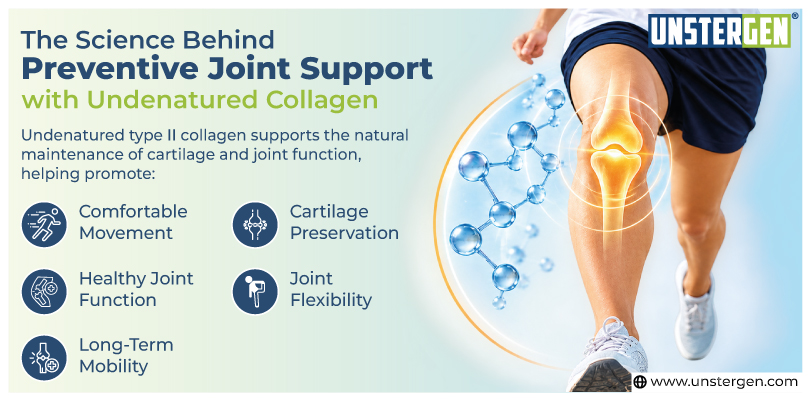
One of the most compelling aspects of undenatured chicken collagen type II is its ability to support joint health before significant cartilage deterioration occurs.
The ingredient is believed to work through a process known as oral tolerance. When small amounts of undenatured type II collagen are consumed, immune cells in the gut recognize the collagen structure. This interaction may help support a balanced immune response toward joint cartilage.
By helping maintain normal cartilage metabolism, undenatured type II collagen may contribute to:
- Cartilage preservation
- Joint flexibility
- Comfortable movement
- Long-term mobility
- Healthy joint function
For preventive health consumers, these benefits align closely with the goal of maintaining mobility rather than waiting for symptoms to develop.
Why Preventive Mobility Is a Growing Consumer Priority
Mobility is becoming one of the most valuable health outcomes in modern wellness.
Consumers increasingly associate mobility with:
- Healthy aging
- Physical independence
- Exercise performance
- Active lifestyles
- Overall quality of life
As a result, mobility-focused products are gaining traction across multiple demographic groups. For nutraceutical brands, this represents an opportunity to move beyond traditional joint pain messaging and embrace broader mobility and active aging positioning.
This shift allows brands to appeal to:
- Adults aged 35 and above
- Active lifestyle consumers
- Recreational athletes
- Fitness enthusiasts
- Healthy aging consumers
- Professionals with physically active work routines
The addressable market becomes significantly larger than the conventional senior-focused joint health segment.
Low-Dose Convenience Creates Formulation Advantages for Brands
One reason undenatured chicken collagen type II has attracted significant industry attention is its low effective dosage. Compared to many traditional joint health ingredients that may require hundreds or thousands of milligrams per serving, undenatured type II collagen is typically incorporated at much lower levels.
This offers several advantages for product developers:
Flexible Product Formats
Brands can formulate capsules, tablets, stick packs, sachets, functional beverages, gummies, and powder blends without excessive serving sizes.
Improved Consumer Compliance
Consumers generally prefer products that require fewer capsules or smaller serving sizes.
Combination Formulation Opportunities
The low inclusion rate leaves room for complementary ingredients such as:
- Boswellia
- Curcumin
- Hyaluronic acid
- Vitamin D
- Magnesium
- Collagen peptides
This flexibility enables brands to create differentiated multi-benefit formulations.
The Convergence of Healthy Aging and Joint Health
The healthy aging category is evolving rapidly. Today’s consumers are less interested in simply extending lifespan and more focused on extending healthspan, the number of years spent living actively and independently.
Joint health plays a critical role in this objective. Mobility limitations are among the most significant factors affecting quality of life as people age. Consequently, maintaining healthy joints has become an essential pillar of healthy aging strategies.
Undenatured chicken collagen type II fits naturally into this narrative by supporting the structures that contribute to joint function and movement. For brands targeting healthy aging consumers, mobility-focused formulations offer a highly relevant and compelling value proposition.
Opportunities in Sports Nutrition
Another emerging trend is the integration of joint health into sports nutrition. Historically, sports nutrition products focused primarily on muscle growth, recovery, and performance.
Today, athletes and active consumers recognize that long-term performance depends not only on muscles but also on healthy joints.
Joint-support ingredients are increasingly appearing in:
- Recovery products
- Nutrition products designed for endurance support
- Performance support formulas
- Endurance nutrition products
Undenatured chicken collagen type II offers brands an opportunity to position joint support as part of a comprehensive active lifestyle strategy. This creates new opportunities beyond the traditional joint health aisle.
Building Premium, Science-Backed Joint Health Formulations
Modern consumers are becoming more selective about the ingredients they purchase.
They increasingly look for:
- Clinical research
- Transparency
- Transparency across the ingredient supply chain
- Scientific credibility
- Evidence-based claims
As a result, ingredient quality has become a major differentiator. Brands that incorporate clinically studied ingredients into their formulations are often better positioned to build trust and command premium pricing.
Undenatured chicken collagen type II aligns well with this trend due to its established research base and distinct biological mechanism. For formulators, the ingredient offers an opportunity to create premium joint health products supported by science rather than commodity positioning.
The Future of Joint Health Is Preventive
The nutraceutical industry is entering a new phase in which prevention is becoming just as important as intervention. Consumers are no longer waiting until mobility declines before seeking support. They are actively investing in solutions that help maintain movement, flexibility, and quality of life over the long term.
This shift is transforming the joint health category. Rather than focusing exclusively on individuals experiencing discomfort, brands can now engage a much broader audience interested in preserving mobility and supporting active lifestyles.
Undenatured chicken collagen type II is well positioned within this evolving landscape. Its unique mechanism, low-dose convenience, clinical support, and relevance to healthy aging make it an attractive ingredient for forward-thinking nutraceutical brands.
Conclusion
Preventive joint health is rapidly emerging as one of the most important opportunities in the nutraceutical industry. Driven by aging populations, active lifestyle trends, and growing consumer interest in proactive wellness, the market is expanding far beyond traditional joint health consumers.
For nutraceutical brands, success will increasingly depend on offering solutions that support mobility before problems arise.
Undenatured chicken collagen type II provides a compelling platform for this new generation of preventive joint health products. By helping support cartilage health, flexibility, and long-term mobility, it enables brands to address one of the most important wellness goals of modern consumers: staying active, independent, and moving comfortably throughout life.
As the industry shifts from symptom management to mobility preservation, preventive joint health is poised to become the next frontier of innovation and growth.
Frequently Asked Questions (FAQ)
Q1. What is preventive joint health and why is it important for consumers?
Preventive joint health refers to nutritional strategies that support cartilage integrity, joint flexibility, and mobility before symptoms of discomfort or deterioration appear, addressing the growing consumer preference for proactive wellness over reactive symptom management.
Q2. How does undenatured chicken collagen type II support joint health?
Undenatured chicken collagen type II works through a mechanism called oral tolerance, where its intact native structure presents specific epitopes to immune cells in the gut known as Peyer’s patches, helping support a balanced immune response toward joint cartilage and promoting cartilage preservation.
Q3. What is the difference between undenatured collagen and hydrolyzed collagen for joints?
Undenatured collagen retains its native three-dimensional molecular structure and works through an oral tolerance immune mechanism, while hydrolyzed collagen is broken into peptides that function primarily as amino acid building blocks, making undenatured type II collagen more targeted for cartilage-specific joint health applications.
Q4. Is undenatured collagen better than glucosamine and chondroitin for joint health?
Undenatured type II collagen works through a distinct oral tolerance mechanism that targets cartilage immunity directly, and clinical research has shown it may deliver joint health benefits at significantly lower daily doses compared to traditional glucosamine and chondroitin supplementation.
Q5. What daily dose of undenatured chicken collagen type II is typically used in supplements?
Undenatured chicken collagen type II is typically used at much lower levels than traditional joint health ingredients, which is one of its key formulation advantages, allowing brands to create smaller serving sizes and leave room for complementary ingredients in combination formulations.
Q6. Which consumer groups benefit most from preventive joint health supplements?
Adults aged 35 and above, recreational athletes, fitness enthusiasts, active lifestyle consumers, and healthy aging consumers all benefit from preventive joint health supplements containing undenatured chicken collagen type II, significantly expanding the addressable market beyond the traditional senior-focused joint health segment.
Q7. Can undenatured chicken collagen type II be used in sports nutrition formulations?
Yes, undenatured type II collagen is increasingly used in sports nutrition recovery products, active nutrition supplements, and performance support formulas, offering joint protection as a key component of comprehensive long-term athletic performance strategies.
Q8. Is Titan Biotech Ltd. a certified manufacturer of undenatured chicken collagen type II in India?
Yes,Titan Biotech Ltd. is a certified undenatured chicken collagen type II manufacturer India-based, producing Unstergen® and supplying to nutraceutical brands, supplement manufacturers, and joint health product developers across India and more than 100 countries globally through www.unstergen.com.
Q9. How can I source bulk undenatured type II collagen for joint health supplement manufacturing?
Contact Titan Biotech Ltd to request Unstergen® samples, certificates of analysis, technical data sheets, and commercial pricing for bulk undenatured chicken collagen type II for preventive joint health and sports nutrition formulations.
About Titan Biotech Ltd.: Manufacturer of Undenatured Chicken Collagen Type II
Titan Biotech Ltd. is manufacturer of nutraceutical, pharmaceutical, and animal nutrition ingredients, supplying high-quality functional ingredients to brands across more than 100 countries. As the manufacturer of Unstergen®, a premium Undenatured Chicken Collagen Type II ingredient, we serve nutraceutical brands, supplement formulators, contract manufacturers, and private label companies seeking a science-backed, clinically aligned joint health ingredient for preventive mobility, healthy aging, and sports nutrition applications.
Unstergen® is produced to preserve the native three-dimensional collagen structure required for the oral tolerance mechanism of action that distinguishes undenatured type II collagen from hydrolyzed alternatives. As a trusted undenatured chicken collagen type II manufacturer India-based and a recognized collagen exporter India nutraceutical companies globally rely on, every batch of Unstergen® is tested for collagen structural integrity, protein content, microbiological safety, and heavy metals before release, ensuring consistent ingredient quality for B2B joint health product development.
Whether you are developing a preventive mobility supplement, a healthy aging joint formula, a sports nutrition recovery product, or a multi-ingredient cartilage support formulation, Titan Biotech Ltd. provides the ingredient quality, clinical documentation, and supply reliability that leading joint health brands demand globally.