

Table of Contents
- Introduction
- What Is Hydrolyzed Chicken Collagen Type II?
- Clinical Evidence Supporting Hydrolyzed Chicken Collagen Type II
- Mechanisms of Action
- Benefits of Hydrolyzed Chicken Collagen
- Comparison with Undenatured Type II Collagen
- Broader Benefits and Safety
- Conclusion
- FAQs
- About Titan Biotech Ltd
- References
Introduction
Hydrolyzed chicken collagen type II has gained significant attention in recent years as a dietary supplement for supporting joint health, particularly in managing symptoms associated with osteoarthritis (OA) and general joint discomfort. Unlike undenatured (native) type II collagen, which works primarily through immune modulation in small doses (often 40 mg/day), hydrolyzed collagen type II undergoes enzymatic breakdown into smaller peptides and amino acids, improving bioavailability and potentially delivering building blocks or bioactive signals to cartilage and joint tissues.
This blog explores the science behind hydrolyzed chicken collagen type II, drawing primarily from clinical studies to examine its potential benefits for joint pain, stiffness, mobility, and overall function. While results are promising in several trials, evidence varies, and not all studies show superiority over placebo in every context.
What Is Hydrolyzed Chicken Collagen Type II?
Type II collagen is the predominant form in articular cartilage, providing structure and elasticity. Hydrolyzed versions are processed (via enzymes) to break down the large collagen molecules into smaller peptides (typically 1-10 kDa), making them easier to absorb in the digestive tract. Chicken sternum cartilage serves as a common source due to its high type II content.
These peptides may reach joint tissues, stimulate chondrocyte activity (cartilage cells), support extracellular matrix synthesis, or exert anti-inflammatory effects. Daily doses in studies often range from several hundred mg to grams, higher than undenatured forms.
Clinical Evidence Supporting Hydrolyzed Chicken Collagen Type II
Several randomized, double-blind, placebo-controlled trials (the gold standard) have investigated it specifically from chicken sources.
One key study evaluated a hydrolyzed chicken collagen type II in adults aged 40-65 with joint discomfort but no major comorbidities or pain medication use. In this double-blind, randomized, placebo-controlled trial, participants took the supplement or placebo for 8 weeks. Assessments used the Western Ontario and McMaster Universities Arthritis Index (WOMAC) covering pain, stiffness, and physical function plus Visual Analog Scale (VAS).
Results showed significant improvements in the HCII group:
- At week 4, overall WOMAC score was reduced by 36.9% vs. 14.3% in placebo (p=0.027).
- Stiffness and physical activity domains improved notably.
- By week 8, reductions reached 48.6% in the HCII group vs. 31.0% in placebo.
The supplement was well-tolerated, with no reported adverse events. This suggests HCII can alleviate joint pain, stiffness, and mobility issues in otherwise healthy adults with mild-to-moderate discomfort.
Another trial focused on hydrolyzed chicken collagen type II combined with other elements, but isolated effects align with joint benefits. Broader meta-analyses on collagen derivatives (including hydrolyzed forms) support small-to-moderate effects on pain (standardized mean difference -0.35) and function (-0.31), with high certainty for safety no increased risk of adverse events or withdrawals compared to controls.
A 2024 randomized, double-blind, placebo-controlled study on oral hydrolyzed collagen (peptides 1-3 kDa) in knee OA patients showed significant reductions in VAS pain, Lequesne algofunctional index, CRP (inflammation marker), and ESR after 6 months (p<0.001 vs. placebo). No adverse effects occurred, highlighting good tolerability and potential as a complement to standard therapy.
Some studies compare or combine hydrolyzed and undenatured forms. A recent randomized trial on combined (undenatured) and hydrolyzed collagen in knee OA found no added benefit over placebo after 12 weeks, despite both groups improving, underscoring that hydrolyzed alone or in specific formulations may suffice in certain populations.
Meta-analyses reinforce collagen derivatives’ efficacy for OA symptoms, including hydrolyzed chicken-derived options, with positive outcomes in WOMAC and VAS scores.
Mechanisms of Action
Hydrolyzed collagen peptides are absorbed intact to some extent and may:
- Provide amino acids (glycine, proline, hydroxyproline) for cartilage repair.
- Stimulate chondrocytes to produce more collagen and proteoglycans.
- Modulate inflammation indirectly, unlike undenatured collagen’s direct oral tolerance mechanism.
Preclinical data support chondroprotective effects, while clinical trials show reduced inflammatory markers like CRP.
Benefits of Hydrolyzed Chicken Collagen
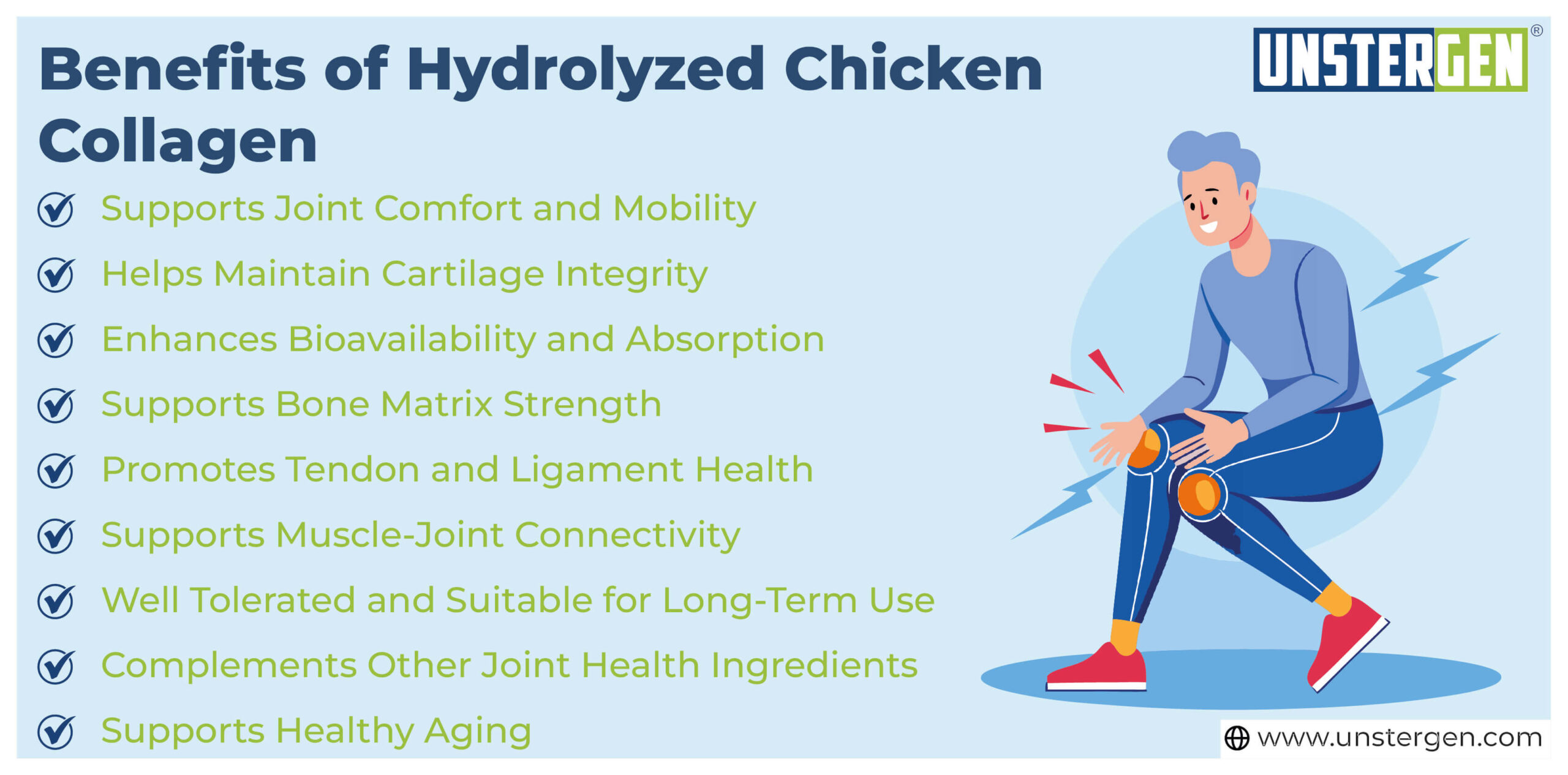
Hydrolyzed chicken collagen offers a wide range of functional benefits due to its high bioavailability, unique peptide profile, and close association with cartilage-rich tissues. Clinical and mechanistic research suggests the following key benefits:
1. Supports Joint Comfort and Mobility
Hydrolyzed chicken collagen provides collagen peptides that contribute to the structural integrity of cartilage, tendons, and ligaments. Regular supplementation has been associated with:
- Reduced joint pain and stiffness.
- Improved range of motion
- Better physical function in individuals with joint discomfort
Clinical studies using WOMAC and VAS scores have shown meaningful improvements in joint comfort and daily mobility with consistent intake.
2. Helps Maintain Cartilage Integrity
Type II collagen is the primary collagen found in articular cartilage. Hydrolyzed chicken collagen supplies peptides that:
- Support cartilage matrix turnover.
- Promote extracellular matrix stability.
- Assist in maintaining cushioning between joints.
This is particularly relevant for aging individuals and those experiencing joint wear due to physical activity.
3. Enhances Bioavailability and Absorption
Because hydrolyzed collagen is enzymatically broken down into low-molecular-weight peptides, it:
- Is easily digested and absorbed.
- Enters systemic circulation efficiently.
- Reaches connective tissues such as joints and cartilage.
This makes hydrolyzed chicken collagen suitable for daily, long-term supplementation.
4. Supports Bone Matrix Strength
Bones rely on a collagen framework for flexibility and tensile strength. Hydrolyzed chicken collagen:
- Contributes amino acids essential for bone collagen synthesis.
- Supports bone matrix quality alongside minerals like calcium.
- May help maintain skeletal strength with aging.
This benefit is especially relevant when combined with vitamin D and calcium.
5. Promotes Tendon and Ligament Health
Tendons and ligaments are rich in collagen fibers. Supplementation with hydrolyzed chicken collagen may help:
- Improve connective tissue resilience.
- Support load-bearing structures around joints.
- Enhance recovery from physical stress.
This makes it useful for active individuals and sports nutrition formulations.
6. Supports Muscle-Joint Connectivity
While collagen is not a complete protein, its amino acid profile supports the connective tissues surrounding muscles. Benefits include:
- Improved musculoskeletal support.
- Enhanced movement efficiency.
- Better joint stability during physical activity.
Some clinical observations also suggest improvements in fat-free mass when used consistently.
7. Well Tolerated and Suitable for Long-Term Use
Clinical trials report hydrolyzed chicken collagen to be:
- Generally safe and well tolerated.
- Easy on digestion.
- Suitable for long-term supplementation.
It is free from common dairy allergens and fits well into clean-label formulations (excluding poultry allergy).
8. Complements Other Joint Health Ingredients
Hydrolyzed chicken collagen works synergistically with:
- Vitamin C (collagen synthesis)
- Hyaluronic acid (joint lubrication)
- Omega-3 fatty acids (inflammation balance)
- Minerals like calcium and magnesium.
This makes it an ideal base ingredient for comprehensive joint health formulations.
9. Supports Healthy Aging
As natural collagen production declines with age, hydrolyzed chicken collagen helps:
- Maintain joint flexibility
- Preserve connective tissue strength.
- Support an active, independent lifestyle.
This positions it as a key ingredient in healthy aging and mobility-focused nutrition.
Comparison with Undenatured Type II Collagen
Undenatured type II collagen from chicken sternum works via gut-associated lymphoid tissue to induce regulatory T-cells, reducing autoimmune attacks on cartilage (doses ~40 mg/day). Studies show benefits in OA and exercise-induced discomfort.
Hydrolyzed forms require higher doses but may offer broader regenerative support. Some reviews note both are effective, with the structure influencing mechanism hydrolyzed for peptide signaling, undenatured for immunomodulation. A trial sequential meta-analysis confirmed strong evidence for collagen derivatives overall, without clear superiority between types in subgroup analyses.
For undenatured Type II chicken collagen, see Unstergen® native chicken collagen product line.
Broader Benefits and Safety
Beyond OA, hydrolyzed collagen supports joint function in active adults or those with activity-related pain. It’s generally safe, with trials reporting no serious adverse events. A meta-analysis emphasized low risk compared to controls.
Conclusion
Hydrolyzed chicken collagen type II shows promising clinical support for reducing joint discomfort, pain, and stiffness while improving function particularly in healthy adults or mild OA cases. Key trials demonstrate statistically significant WOMAC and VAS improvements, backed by meta-analyses confirming efficacy and safety of collagen derivatives.
As research evolves, it positions HCII as a valuable nutritional tool for proactive joint health. For those seeking natural support, evidence-based hydrolyzed chicken type II collagen offers a science-backed option worth considering.
Looking for premium hydrolyzed chicken Type II collagen or native collagen solutions? Titan Biotech Ltd manufactures both hydrolyzed and Unstergen® undenatured Type II chicken collagen for nutraceutical formulations. Contact us for specifications.
Frequently Asked Questions (FAQs)
1. What is hydrolyzed Chicken Type II collagen?
Hydrolyzed Type II collagen is chicken sternum-derived collagen that has been enzymatically broken down into smaller peptides (1-10 kDa) for enhanced digestive absorption and bioavailability. It supplies amino acids and bioactive peptides to support joint cartilage.
2. How is hydrolyzed collagen different from undenatured collagen?
Hydrolyzed collagen is broken into peptides for absorption and works by supplying building blocks to cartilage. Undenatured collagen (like Unstergen®) retains its native structure and works through immune modulation at much lower doses (40mg vs several hundred mg).
3. What are the proven benefits of hydrolyzed chicken collagen for joints?
Clinical trials show hydrolyzed chicken type II collagen reduces joint pain, stiffness, and improves mobility. One 8-week study showed 48.6% improvement in WOMAC scores vs. 31% placebo, with significant reductions in pain and stiffness.
4. How long does it take to see results from hydrolyzed chicken type II collagen?
Clinical studies show improvements beginning at 4 weeks (36.9% WOMAC reduction) with continued benefits at 8 weeks (48.6% reduction). Most trials recommend 2-6 months of consistent use for optimal joint health support.
5. What is the recommended dosage of hydrolyzed chicken type II collagen?
Clinical studies typically use several hundred mg to several grams daily, much higher than undenatured forms. Specific dosing depends on the formulation and individual needs. Consult product guidelines or a healthcare professional.
6. Is hydrolyzed chicken collagen safe for long-term use?
Yes. Clinical trials report hydrolyzed chicken collagen is generally safe and well-tolerated with no serious adverse events. It is suitable for long-term supplementation in individuals without poultry allergies.
7. Can hydrolyzed collagen help with osteoarthritis?
Yes. Multiple randomized controlled trials and meta-analyses show hydrolyzed collagen derivatives improve pain, stiffness, and function in osteoarthritis patients, with effects measured by WOMAC and VAS scores. A 2024 study also showed reduced CRP inflammation markers.
8. Does hydrolyzed chicken type II collagen work better than glucosamine?
Research is mixed. Some studies suggest comparable or complementary benefits. Hydrolyzed collagen may offer broader connective tissue support beyond cartilage, while glucosamine focuses on cartilage building blocks. They are often combined in formulations.
9. Can I take hydrolyzed collagen with other joint supplements?
Yes. Hydrolyzed chicken collagen works synergistically with vitamin C (for collagen synthesis), hyaluronic acid, omega-3 fatty acids, calcium, and magnesium. This makes it ideal for comprehensive joint health formulations.
10. Who should consider hydrolyzed chicken type II collagen supplementation?
Individuals with mild-to-moderate joint discomfort, aging adults experiencing mobility issues, active individuals with exercise-related joint stress, and those seeking proactive joint health support may benefit from hydrolyzed chicken collagen.
About Titan Biotech Ltd
Titan Biotech Ltd is a leading manufacturer and exporter of pharmaceutical ingredients, nutraceutical ingredients, and specialized health compounds for the global dietary supplement industry. With state-of-the-art, GMP-certified manufacturing facilities, we produce premium-quality collagen ingredients including both hydrolyzed chicken collagen type II and Unstergen® undenatured chicken collagen Type II, serving pharmaceutical companies, nutraceutical formulators, and joint health product manufacturers across India and international markets.