
Table of Content
- Introduction
- Understanding Collagen: The Body’s Structural Framework
- What Is Type I Collagen?
- What Is Type II Collagen?
- The Fundamental Difference: Structure vs. Immune Modulation
- Why Type II Collagen Is More Relevant for Joint Health Products
- Clinical Interest in Undenatured Type II Collagen
- Can Type I Collagen Still Benefit Joint Health?
- The Rise of Combination Formulations
- Choosing the Right Collagen for Your Product Strategy
- Market Trends Driving Type II Collagen Adoption
- Future of Joint Health Formulations
- Conclusion
- Frequently Asked Questions (FAQ)
- About Titan Biotech Ltd
- References
Introduction
The global joint health market is evolving rapidly as consumers increasingly seek science-backed solutions to support mobility, flexibility, and active aging. Among the most widely recognized ingredients in this category, collagen has emerged as a key player. However, not all collagen is the same.
One of the most common questions among formulators, brand owners, and product developers is: Should a joint health product contain Type I collagen or Type II collagen? While both are important structural proteins found naturally in the body, they differ significantly in terms of biological function, tissue distribution, mechanism of action, and application in nutraceutical formulations.
Understanding these differences is essential for selecting the right ingredient and developing products that meet consumer expectations and clinical objectives.
Understanding Collagen: The Body’s Structural Framework
Collagen is the most abundant protein in the human body and serves as the primary structural component of connective tissues. It provides strength, elasticity, and support to various tissues including skin, bones, tendons, ligaments, and cartilage. More than 28 different types of collagen have been identified, but Types I and II are among the most commercially relevant for nutraceutical applications.Although both types belong to the same collagen family, their biological roles are distinctly different.
What Is Type I Collagen?
Type I collagen is the most abundant collagen in the human body, accounting for approximately 90% of total collagen. It is primarily found in:
- Skin
- Bones
- Tendons
- Ligaments
- Teeth
- Connective tissues
Its primary function is to provide tensile strength and structural integrity to tissues that require durability and resistance to stretching forces.
Key Benefits of Type I Collagen
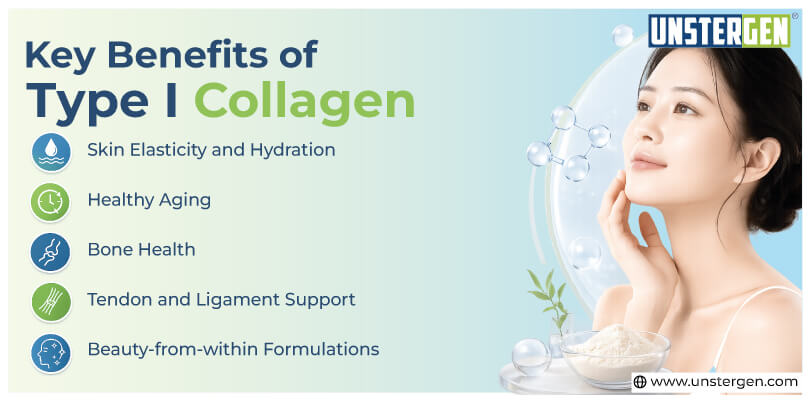
Type I collagen is commonly used in nutraceuticals targeting:
- Skin elasticity and hydration
- Healthy aging
- Bone health
- Tendon and ligament support
- Beauty-from-within formulations
Most commercial Type I collagen ingredients are available as hydrolyzed collagen peptides, which are broken down into smaller amino acid chains for improved absorption.
Why Brands Use Type I Collagen?
For brands targeting beauty, healthy aging, sports recovery, and bone health, Type I collagen remains a preferred choice because of its strong scientific association with skin and connective tissue support.
However, when the primary goal is cartilage health and joint comfort, Type I collagen may not always be the most targeted solution.
What Is Type II Collagen?
Type II collagen is the dominant collagen found in articular cartilage, the smooth tissue that cushions joints and facilitates movement. Research suggests that Type II collagen accounts for approximately 90 to 95% of the collagen present in cartilage, making it the most relevant collagen type for joint health applications. Unlike Type I collagen, which mainly provides structural support to skin and bones, Type II collagen is directly involved in maintaining cartilage integrity and joint function.
Sources of Type II Collagen
Commercial Type II collagen is typically derived from chicken sternum cartilage and is available in two primary forms:
- Hydrolyzed Type II Collagen
- Undenatured Type II Collagen
Among these, undenatured Type II collagen has gained significant attention because of its unique mechanism of action.
The Fundamental Difference: Structural Support vs Immune Modulation
Type I Collagen: Structural Support
Hydrolyzed Type I collagen primarily functions as a source of amino acids and peptides.After ingestion, it is digested and absorbed, providing building blocks that may support the body’s natural collagen synthesis processes.
Type II Collagen: Targeted Joint Support
Undenatured Type II collagen works differently.
Instead of simply acting as a source of amino acids, its native structure remains intact. This intact structure contains specific epitopes that interact with immune tissues in the gut known as Peyer’s patches. This interaction promotes a process known as oral tolerance, which may help the immune system recognize joint cartilage components and reduce unwanted immune responses associated with cartilage degradation.
This unique mechanism is one reason why undenatured Type II collagen is often used at very low daily doses compared with traditional collagen peptides.
Why Type II Collagen Is More Relevant for Joint Health Products?
When formulating a product specifically for joint health, it is important to consider where each collagen type naturally occurs in the body.
| Feature | Type I Collagen | Type II Collagen |
|---|---|---|
| Main Location | Skin, bones, tendons, ligaments | Cartilage |
| Primary Function | Structural strength | Cartilage integrity |
| Typical Applications | Beauty, healthy aging, bone health | Joint health and mobility |
| Common Form | Hydrolyzed peptides | Undenatured or hydrolyzed |
| Joint-Specific Targeting | Indirect | Direct |
For products aimed at:
- Joint comfort
- Joint mobility
- Cartilage preservation
- Active aging
- Sports recovery
Type II collagen generally offers a more targeted approach because it directly relates to cartilage structure and function.
Clinical Interest in Undenatured Type II Collagen
The growing popularity of undenatured Type II collagen is largely driven by clinical research.
Several studies have demonstrated improvements in:
- Joint comfort
- Physical function
- Mobility
The International Journal of Research in Orthopaedics review highlighted that undenatured Type II collagen may help support cartilage health through immune-mediated pathways and has demonstrated favorable safety and tolerability profiles.
Unlike many conventional joint support ingredients that focus primarily on symptom management, undenatured Type II collagen offers a mechanism that addresses immune responses associated with cartilage degradation.
Can Type I Collagen Still Benefit Joint Health?
The answer is yes.
Although Type I collagen is not the primary collagen found in cartilage, it contributes to the health of several structures surrounding joints, including:
- Tendons
- Ligaments
- Bones
This means Type I collagen may still play a supportive role in overall musculoskeletal health. For example, athletes and physically active consumers often benefit from ingredients that support both joint structures and connective tissues. However, when the formulation objective is specifically cartilage-focused joint health, Type II collagen generally provides a more direct biological match.
The Rise of Combination Formulations
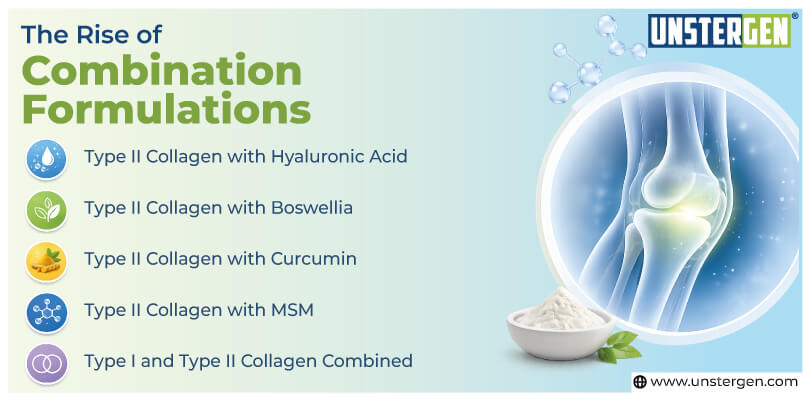
Many modern joint health supplements combine Type II collagen with complementary ingredients to provide broader support.
Type II Collagen with Hyaluronic Acid
Supports cartilage lubrication and joint cushioning.
Type II Collagen with Boswellia
Addresses inflammation pathways while supporting mobility.
Type II Collagen with Curcumin
Provides antioxidant and inflammatory response support.
Type II Collagen with MSM
Supports connective tissue health and joint comfort.
Type I and Type II Collagen Combined
Offers a comprehensive approach that supports:
- Cartilage
- Tendons
- Ligaments
- Bones
- Overall joint function
This combination is increasingly popular in active aging and sports nutrition products.
Choosing the Right Collagen for Your Product Strategy
The ideal collagen type depends on your target consumer and formulation objectives.
Choose Type I Collagen If Your Product Focuses On:
- Beauty-from-within
- Healthy skin aging
- Bone health
- Sports recovery
- Connective tissue support
Choose Type II Collagen If Your Product Focuses On:
- Joint mobility
- Cartilage support
- Active aging
- Osteoarthritis management
- Exercise-related joint discomfort
Consider Combining Both If Your Product Focuses On:
- Comprehensive musculoskeletal health
- Active lifestyles
- Sports nutrition
- Healthy aging solutions
Market Trends Driving Type II Collagen Adoption
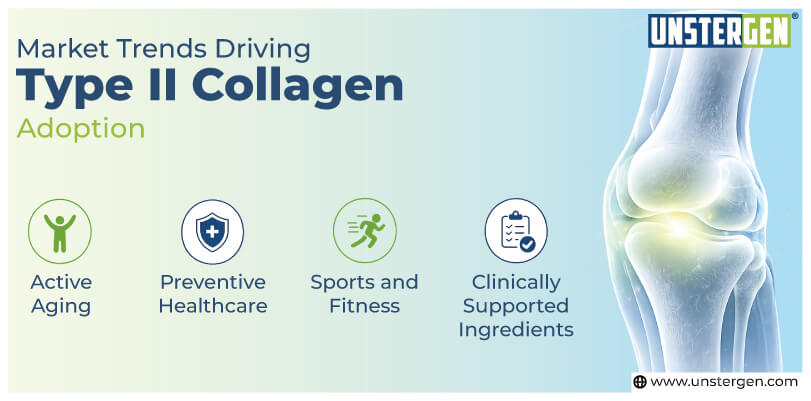
Several consumer trends are accelerating demand for Type II collagen.
i) Active Aging
Consumers are seeking solutions that help maintain mobility and independence as they age.
ii) Preventive Healthcare
Joint health is increasingly viewed as a proactive wellness category rather than a reactive one.
iii) Sports and Fitness
Athletes and fitness enthusiasts are looking for ingredients that support long-term joint performance.
iv) Clinically Supported Ingredients
Brands are increasingly prioritizing ingredients backed by human clinical studies and clearly defined mechanisms of action. These trends position Type II collagen as one of the most attractive ingredients in the joint health category.
Future of Joint Health Formulations
The joint health market is moving beyond traditional ingredients and toward more targeted, mechanism-based solutions.
As scientific understanding of cartilage biology and immune modulation advances, Type II collagen is expected to play an increasingly important role in next-generation joint health products.
For formulators and brand owners, understanding the differences between collagen types is no longer optional. It is essential for creating products that resonate with consumers and deliver meaningful benefits.
Conclusion
While both Type I and Type II collagen contribute to overall musculoskeletal health, they serve fundamentally different purposes. Type I collagen is the body’s primary structural collagen, supporting skin, bones, tendons, and ligaments. It is ideal for beauty, healthy aging, and connective tissue applications.
Type II collagen, on the other hand, is the principal collagen found in cartilage and offers a more targeted approach to joint health. Its unique role in cartilage structure and the oral tolerance mechanism associated with undenatured forms make it particularly relevant for mobility and joint support formulations.
For brands developing dedicated joint health products, Type II collagen is often the more strategic choice.
Frequently Asked Questions (FAQ)
Q1. What is the main difference between Type I and Type II collagen for joint health?
Answer. Type I collagen is primarily found in skin, bones, tendons, and ligaments and provides structural strength, while Type II collagen is the main collagen in articular cartilage and is specifically relevant for joint health and cartilage integrity, making it the more targeted choice for joint supplement formulations.
Q2. Which collagen type is best for joint health supplements?
Answer. Type II collagen, particularly undenatured Type II collagen such as Unstergen®, is generally considered the most suitable for joint health products because it is the predominant collagen present in cartilage and directly supports joint function through both structural and immune-modulating mechanisms.
Q3. Is Type I collagen still beneficial for joints?
Answer. Yes, Type I collagen supports the tendons, ligaments, and bones surrounding joints, contributing to overall musculoskeletal health, though it does not directly target cartilage the way Type II collagen does.
Q4. What is undenatured Type II collagen and how does it work?
Answer. Undenatured Type II collagen, like Unstergen® produced by Titan Biotech Ltd., retains its native three-dimensional structure and works through an oral tolerance mechanism, interacting with Peyer’s patches in the gut to help reduce immune responses associated with cartilage degradation.
Q5. Can Type I and Type II collagen be combined in one formulation?
Answer. Yes, many advanced joint health and active aging formulations combine Type I and Type II collagen to support cartilage, tendons, ligaments, bones, and overall joint function, making them suitable for comprehensive musculoskeletal health products.
Q6. Why is Type II collagen commonly sourced from chicken sternum cartilage?
Answer. Chicken sternum cartilage is naturally rich in Type II collagen, providing a concentrated and commercially reliable source, which is why Unstergen® undenatured chicken collagen Type II is derived from chicken sternum as its primary raw material.
Q7. Is hydrolyzed collagen the same as undenatured collagen?
Answer. No, hydrolyzed collagen is broken into smaller peptides to aid absorption and provides structural amino acids, whereas undenatured collagen like Unstergen® maintains its native structure and works through a distinct immune-modulating oral tolerance mechanism at very low doses.
Q8. What types of consumers benefit most from Type II collagen products?
Answer. Older adults, active individuals, athletes, and consumers seeking joint mobility, cartilage support, and osteoarthritis management are the primary target consumers for undenatured Type II collagen supplements.
Q9. Is Titan Biotech Ltd. a certified manufacturer of undenatured Type II collagen in India?
Answer. Yes, Titan Biotech Ltd. is a certified undenatured Type II collagen manufacturer India-based, producing Unstergen® Undenatured Chicken Collagen Type II and supplying to nutraceutical brands, contract manufacturers, and joint health product developers across India and global markets through www.unstergen.com.
Q10. How can I source bulk undenatured Type II collagen for joint health supplement manufacturing?
Answer. Contact Titan Biotech Ltd. through www.unstergen.com to request samples, certificates of analysis, technical data sheets, and commercial pricing for Unstergen® undenatured chicken collagen Type II for joint health nutraceutical formulations.
About Titan Biotech Ltd.: Manufacturer of Unstergen® Undenatured Chicken Collagen Type II
Titan Biotech Ltd. is an Indian manufacturer of nutraceutical, pharmaceutical, and animal nutrition ingredients, supplying high-quality functional ingredients to brands across more than 100 countries. As a dedicated undenatured Type II collagen manufacturer India-based and internationally recognized, we produce Unstergen®, a premium Undenatured Chicken Collagen Type II ingredient derived from chicken sternum cartilage and developed specifically for joint health nutraceutical formulations.
Unstergen® is manufactured to preserve the native three-dimensional collagen structure required for the oral tolerance mechanism of action that distinguishes undenatured Type II collagen from hydrolyzed alternatives. As a trusted undenatured collagen exporter India nutraceutical brands and global supplement companies rely on, every batch of Unstergen® is tested for collagen integrity, protein content, microbiological safety, and heavy metals before release, ensuring consistent ingredient quality for joint health product development.
Titan Biotech Ltd. operates as a B2B collagen raw material manufacturer and technical partner to nutraceutical companies, contract manufacturers, and joint health brands worldwide. Titan Biotech Ltd. delivers the ingredient quality, clinical alignment, and supply reliability that leading joint health brands demand.