
Table of Content
- Introduction
- Understanding Joint Degeneration and Cartilage Breakdown
- Why Early Detection of Joint Problems Matters?
- 10 Early Warning Signs of Joint Degeneration
- Risk Factors That Accelerate Joint Degeneration
- The Role of Collagen in Joint Health and Cartilage Support
- What is Undenatured Chicken Collagen Type II?
- How Undenatured Chicken Collagen Type II Supports Joint Health?
- Who Can Benefit from Joint Health Support?
- Lifestyle Strategies to Protect Joints Early
- Nutritional Support for Maintaining Joint Health
- when to Consider Joint Support Supplements?
- Preventive Joint Care as a Future Health Strategy
- Conclusion
- About Titan Biotech Ltd
- Frequently Asked Questions (FAQ)
- References
Introduction
Joint health is something most people take for granted until discomfort begins. Joint degeneration does not happen overnight. It is a gradual process that may begin silently with mild symptoms that people often ignore. By the time severe pain appears, significant cartilage damage may already have occurred.
Joint degeneration is now increasingly affecting people of all age groups, not just seniors. Sedentary lifestyles, obesity, sports injuries, nutritional deficiencies, and long working hours are contributing to earlier joint problems even in people in their 30s and 40s.
The good news is that early identification of symptoms combined with proper nutrition, lifestyle changes, and scientifically supported ingredients such as undenatured chicken collagen type II can help maintain joint comfort and mobility.
This article explains the early warning signs of joint degeneration and how targeted nutritional support can help maintain long-term joint health.
Understanding Joint Degeneration and Cartilage Breakdown
Joint degeneration commonly refers to the gradual breakdown of cartilage, the smooth tissue that cushions joints. This process is often associated with osteoarthritis, the most common joint disorder worldwide.
Cartilage plays an important role by:
- Reducing friction between bones
- Absorbing shock
- Supporting smooth movement
- Maintaining joint flexibility
When cartilage begins to wear down:
- Friction increases
- Inflammation may occur
- Joint movement becomes uncomfortable
- Stiffness develops
Research shows osteoarthritis involves destruction of cartilage and changes in surrounding bone structures, leading to pain and reduced mobility.
Why Early Detection of Joint Problems Matters?
Ignoring early joint symptoms can allow degeneration to progress. Early intervention can help:
- Slow cartilage breakdown
- Maintain flexibility
- Reduce inflammation risk
- Preserve mobility
- Improve quality of life
Preventive joint care is much easier than managing advanced degeneration.
10 Early Warning Signs of Joint Degeneration
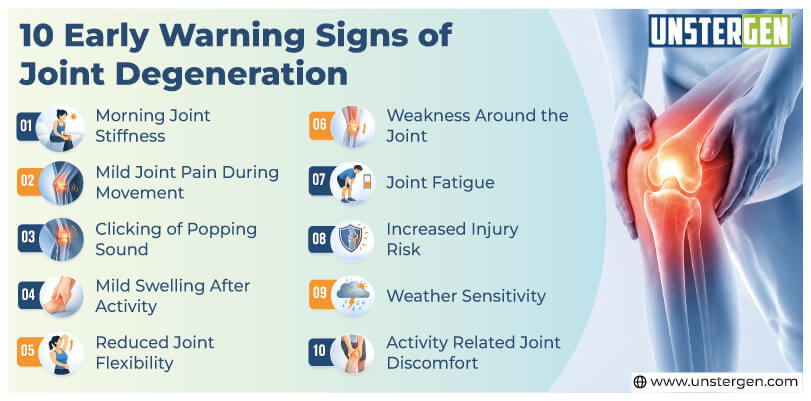
1. Morning Joint Stiffness
One of the earliest signs of joint problems is stiffness after waking up or after long periods of inactivity.
Typical signs include:
- Difficulty bending knees
- Tightness in fingers
- Reduced mobility after sitting
This stiffness usually improves with movement but should not be ignored if it becomes frequent.
2. Mild Joint Pain During Movement
Early joint degeneration often starts as discomfort only during activity.
Examples include:
- Pain while climbing stairs
- Knee discomfort during exercise
- Shoulder pain while lifting
Initially, pain may disappear with rest, which causes many people to ignore it.
3. Clicking or Popping Sounds
A cracking or popping sound (crepitus) may indicate early cartilage wear.
Possible causes include:
- Cartilage thinning
- Ligament movement
- Gas bubbles in joint fluid
Occasional sounds may be harmless, but frequent sounds with discomfort may indicate degeneration.
4. Reduced Joint Flexibility
You may notice difficulty performing movements that were previously easy.
Examples:
- Difficulty squatting
- Trouble touching toes
- Reduced shoulder rotation
Loss of flexibility often occurs before significant pain develops.
5. Mild Swelling After Activity
Inflammation is the body’s response to joint stress.
Early swelling may appear:
- After long walks
- After workouts
- After repetitive movements
Swelling that keeps recurring may indicate early joint stress.
6. Weakness Around the Joint
Joint degeneration may also affect surrounding muscles.
Signs include:
- Knee weakness
- Reduced grip strength
- Shoulder instability
Muscle weakness increases joint load and may accelerate degeneration.
7. Joint Fatigue
You may feel your joints get tired faster than before.
Examples:
- Knees feel tired after standing
- Wrist fatigue during typing
- Back fatigue during sitting
This often indicates declining joint efficiency.
8. Increased Injury Risk
Early degeneration may make joints more vulnerable to minor injuries.
Examples include:
- Frequent sprains
- Minor ligament strain
- Delayed recovery after activity
Healthy joints typically recover quickly, so repeated injuries may signal a problem.
9. Weather Sensitivity
Some individuals notice joint discomfort during weather changes.
Possible causes include:
- Pressure changes
- Joint inflammation
- Fluid pressure variations
10. Activity-Related Joint Discomfort
Research shows some individuals experience discomfort during physical stress even before diagnosed joint disease. Clinical studies evaluating undenatured collagen involved subjects experiencing activity-related joint discomfort despite being otherwise healthy. This shows joint stress symptoms can appear even before clinical diagnosis.
Risk Factors That Accelerate Joint Degeneration
Several lifestyle factors increase joint degeneration risk:
Age: Natural collagen production declines with age.
Obesity: Excess weight increases joint pressure.
Sports injuries: Past injuries increase future degeneration risk.
Nutritional gaps: Poor intake of joint nutrients affects cartilage repair.
The Role of Collagen in Joint Health and Cartilage Support
Collagen is the main structural protein in cartilage.
Type II collagen specifically:
- Maintains cartilage structure
- Supports elasticity
- Provides tensile strength
Research shows type II collagen is a major component of cartilage matrix and plays a key role in joint integrity. As collagen declines, cartilage strength may reduce.
What is Undenatured Chicken Collagen Type II?
Undenatured type II collagen is a specialized form of collagen derived from chicken sternum cartilage. Unlike hydrolyzed collagen, it maintains its natural structure.
Its uniqueness lies in:
- Preserved biological structure
- Immune modulation mechanism
- Low effective dose
- Cartilage support properties
Research shows oral administration of undenatured type II collagen may help reduce osteoarthritis symptoms and support joint health.
How Undenatured Chicken Collagen Type II Supports Joint Health?
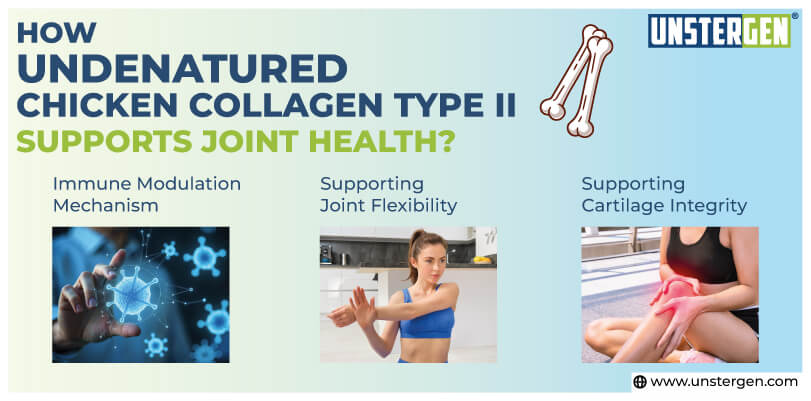
It works differently from traditional joint supplements.
Immune Modulation Mechanism
It works through a process called oral tolerance, where the immune system becomes less reactive toward joint cartilage.
This may help:
- Reduce cartilage breakdown
- Support joint comfort
- Maintain flexibility
Supporting Joint Flexibility
Clinical studies show supplementation improved knee flexibility and reduced activity-related discomfort in healthy adults.
Supporting Cartilage Integrity
It helps maintain cartilage by supporting the body’s natural repair mechanisms.
Benefits may include:
- Improved joint comfort
- Better mobility
- Reduced stiffness
Who May Benefit from Undenatured Chicken Collagen Type II?
It may benefit:
- Adults above 30
- Athletes
- Office workers
- Active individuals
- People with early joint discomfort
- Aging populations
Preventive use may help maintain joint health.
Lifestyle Strategies to Protect Joints Early
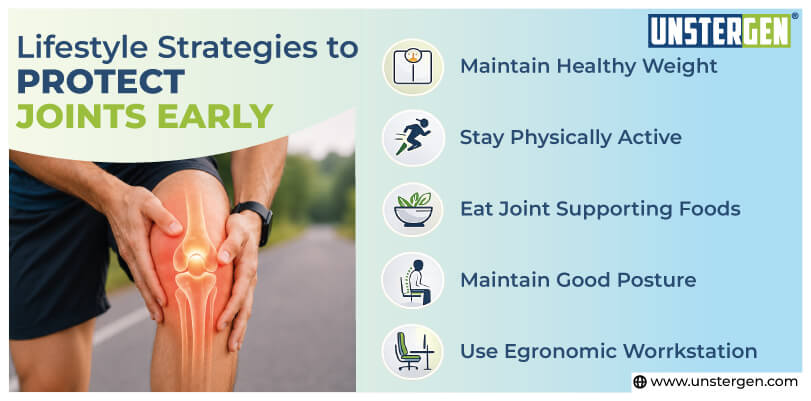
Nutrition alone is not enough. Joint care should include:
a. Maintain Healthy Weight
Reducing excess weight reduces joint stress.
b. Stay Physically Active
Low-impact exercises help:
- Strengthen muscles
- Improve mobility
- Support joint lubrication
c. Eat Joint Supporting Foods
- Protein
- Vitamin C
- Omega-3 fatty acids
- Antioxidants
d. Maintain Good Posture
Poor posture increases joint strain.
e. Use Ergonomic Workstations
Important for desk workers.
Nutritional Support for Maintaining Joint Health
Key nutrients include:
- Undenatured type II collagen
- Glucosamine
- Chondroitin
- MSM
- Omega-3
- Vitamin
- Magnesium
Among these, Undenatured Chicken Collagen is gaining attention due to its low dose and clinical support.
When to Consider Joint Support Supplements?
Consider joint nutrition support if you notice:
- Regular stiffness
- Activity discomfort
- Reduced flexibility
- Early pain signs
- Recovery delays
Early support may be more effective than late intervention.
Preventive Joint Care as a Future Health Strategy
Modern joint care is shifting from treatment to prevention.
Key principles include:
- Early detection
- Nutritional support
- Active lifestyle
- Weight management
- Regular movement
Prevention helps maintain long-term mobility.
Conclusion
Joint degeneration is a gradual process that often begins with small warning signs such as stiffness, mild pain, reduced flexibility, and activity discomfort. Ignoring these symptoms may allow long-term damage to develop.
Early intervention through lifestyle changes and targeted nutrition can help maintain joint health. Scientifically studied ingredients such as undenatured chicken collagen type II offer promising support by helping maintain joint flexibility, comfort, and cartilage health.
Taking care of your joints early is one of the best investments you can make for long-term mobility and active aging.
About Titan Biotech Ltd: Undenatured Collagen Type II for Joint Health
Titan Biotech Ltd is a recognized biotechnology and nutraceutical ingredient manufacturer specializing in advanced animal-derived health ingredients. The company is committed to producing science-backed solutions for joint health, animal nutrition, and functional foods.
Unstergen® is Titan Biotech’s branded undenatured chicken collagen type II product, specifically developed for joint health applications in the nutraceutical and functional food industries.
Unstergen® from Titan Biotech Ltd represents a scientifically validated approach to supporting joint health and maintaining mobility from the earliest stages. For those seeking to share knowledge about joint degeneration prevention and undenatured collagen benefits, Unstergen® provides a reliable, research-backed solution.
Frequently Asked Questions (FAQs)
Q1. What are the first signs of joint degeneration?
Early signs include stiffness, mild pain, reduced flexibility, and activity discomfort.
Q2. At what age does joint degeneration start?
It can begin as early as the 30s depending on lifestyle and risk factors.
Q3. Can early joint degeneration be reversed?
While cartilage cannot fully regenerate, early care can slow progression and maintain function.
Q4. Is joint stiffness always arthritis?
Not always, but persistent stiffness should be evaluated.
Q5. How does Undenatured Chicken Collagen differ from normal collagen?
It works through immune modulation while regular collagen mainly provides amino acids.
Q6. How long does Undenatured chicken collagen take to show benefits?
Clinical studies suggest improvements may appear within 8-24 weeks.
Q7. Can young adults take joint supplements?
Yes, especially if they have early symptoms or high joint stress.
Q8. Is exercise good for joint degeneration?
Yes, low-impact exercise supports joint mobility and strength.
Q9. Can diet affect joint health?
Yes, poor nutrition may accelerate degeneration while balanced nutrition supports joints.
Q10. Who should consider Undenatured chicken collagen supplementation?
People with early joint discomfort, active lifestyles, aging adults, and athletes may benefit.