

Table of Contents
- Introduction: Aging and Degenerative Joint Disorders
- Understanding Undenatured Chicken Collagen Type II
- Pathophysiology of Joint Degeneration in the Elderly
- Mechanism of Action of Undenatured Chicken Collagen Type II
- Clinical Evidence Supporting Use in Elderly Patients
- Safety and Tolerability in the Elderly
- Practical Considerations for Clinical and Nutritional Use
- Relevance to Quality of Life in Aging
- Future Perspectives and Research Needs
- About Titan Biotech Ltd
- Conclusion
- FAQs
- References
Introduction: Aging and Degenerative Joint Disorders
With advancing age, musculoskeletal health undergoes significant deterioration, primarily due to reduced regenerative capacity of cartilage, increased inflammation, and altered immune responses. Osteoarthritis (OA), the most prevalent degenerative joint disorder among the elderly, is characterized by progressive cartilage loss, joint pain, stiffness, and reduced mobility. These changes substantially affect independence and quality of life.
Articular cartilage is composed largely of type II collagen, which provides tensile strength and structural integrity. Aging leads to a decline in collagen synthesis and accelerated breakdown of cartilage matrix components. Conventional pharmacological treatments such as NSAIDs offer symptomatic relief but do not address the underlying degenerative processes and may pose gastrointestinal, renal, or cardiovascular risks in elderly patients.
As a result, attention has shifted toward safe, disease-modifying nutritional interventions, among which undenatured chicken collagen type II has gained increasing scientific and clinical interest.
Understanding Undenatured Chicken Collagen Type II
Undenatured chicken collagen type II is a native form of collagen extracted from chicken sternum cartilage under controlled, low-temperature conditions. Unlike hydrolyzed or denatured collagen, this form retains its intact triple-helical molecular structure and biologically active epitopes.
This structural integrity is crucial, as it allows the collagen to interact with the immune system in a unique manner, enabling physiological mechanisms that extend beyond simple structural supplementation. Preservation of native collagen conformation distinguishes undenatured collagen from other collagen preparations commonly used in joint health supplements.
Pathophysiology of Joint Degeneration in the Elderly
Aging joints are affected by several interrelated pathological processes:
- Reduced synthesis of type II collagen and proteoglycans
- Increased activity of matrix-degrading enzymes
- Chronic low-grade inflammation
- Thinning of cartilage and loss of shock-absorbing capacity
- Altered synovial fluid composition
Together, these changes lead to pain, stiffness, restricted range of motion, and functional disability. Addressing both structural degeneration and inflammatory dysregulation is therefore essential for effective long-term management in elderly patients.
Mechanism of Action of Undenatured Chicken Collagen Type II
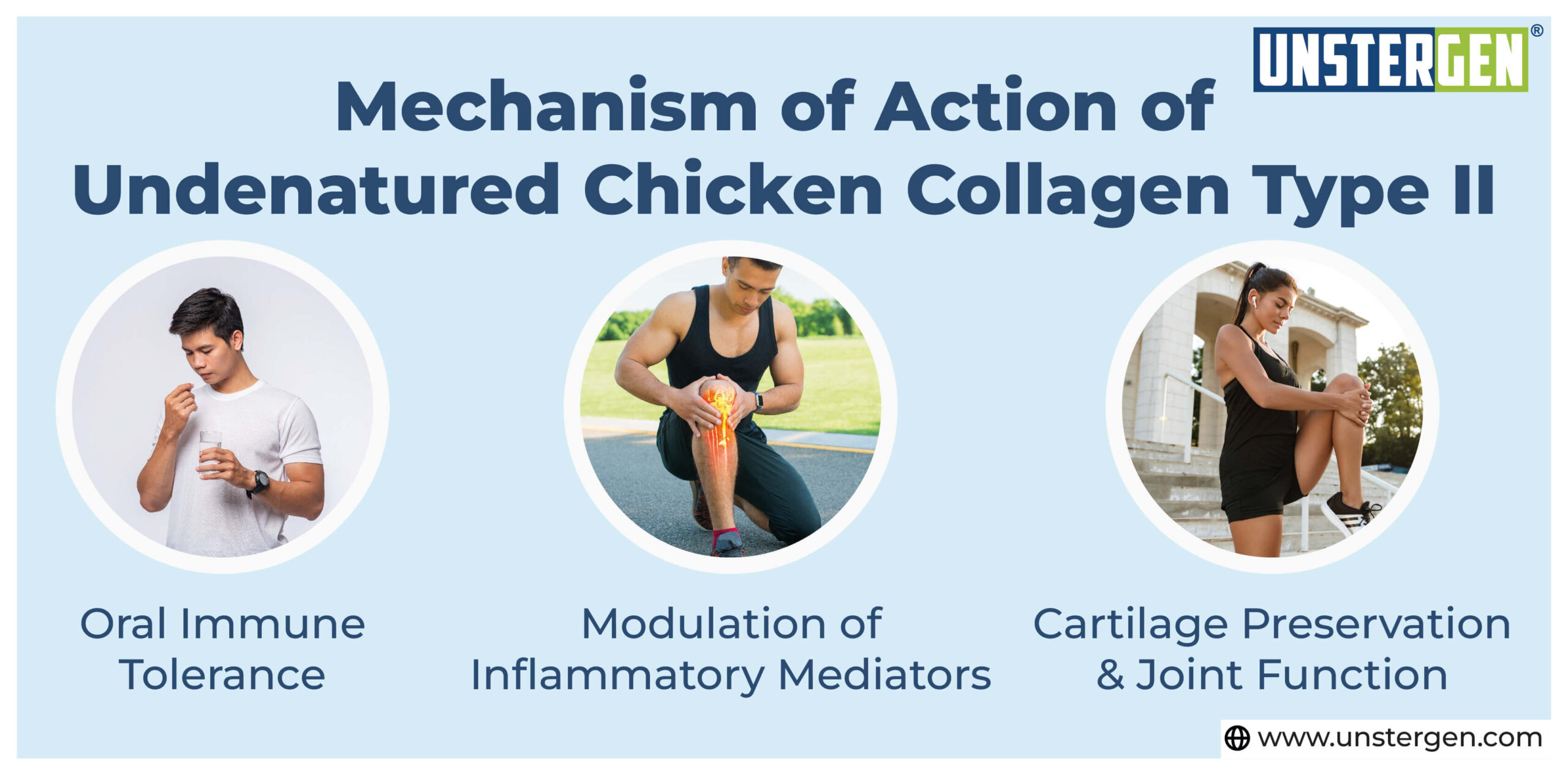
Oral Immune Tolerance
One of the most significant mechanisms associated with undenatured chicken collagen type II is oral immune tolerance. When consumed orally, small amounts of intact collagen reach the gut-associated lymphoid tissue, particularly Peyer’s patches in the small intestine.
Here, immune cells recognize the collagen epitopes and induce regulatory T-cell responses that suppress inappropriate inflammatory reactions directed toward joint cartilage. This immune modulation helps reduce cartilage-specific inflammation, which is a key contributor to joint degeneration in aging individuals.
Modulation of Inflammatory Mediators
Preclinical and clinical studies demonstrate that undenatured chicken collagen type II can help regulate inflammatory cytokines such as tumor necrosis factor-alpha (TNF-α) and interleukins involved in cartilage breakdown. Simultaneously, it may support anabolic signaling pathways that promote cartilage maintenance.
Cartilage Preservation and Joint Function
By modulating immune responses and inflammatory cascades, undenatured chicken collagen type II supports cartilage integrity, reduces pain sensitivity, and improves joint biomechanics. This dual action makes it particularly relevant for elderly patients experiencing chronic joint degeneration.
Clinical Evidence Supporting Use in Elderly Patients
Osteoarthritis-Focused Clinical Studies
Clinical trials involving adults with osteoarthritis have shown that daily supplementation with undenatured chicken collagen type II significantly improves:
- Joint pain scores
- Joint stiffness
- Physical function and mobility
- Overall quality of life
Notably, improvements were observed using low daily doses, highlighting its potency and suitability for long-term use in older populations.
Functional Outcomes and Mobility
Studies assessing functional endpoints such as WOMAC scores, pain rating scales, and range of motion demonstrate meaningful improvements within 8-12 weeks of supplementation. These outcomes are particularly important for elderly patients, as enhanced mobility directly correlates with reduced fall risk, better independence, and improved mental well-being.
Comparison with Conventional Supplements
Unlike glucosamine or chondroitin, which require gram-level dosing and primarily provide structural building blocks, undenatured chicken collagen type II works at the immunological level, offering a complementary and often superior approach for joint support in aging individuals.
Safety and Tolerability in the Elderly
Safety is a critical consideration for elderly patients who often take multiple medications. Clinical trials consistently report that undenatured chicken collagen type II is well tolerated, with no serious adverse events attributed to supplementation.
Key safety advantages include:
- Very low effective daily dose
- Minimal gastrointestinal burden
- No known renal or cardiovascular risks
- Suitable for long-term use
These features make it an attractive alternative or adjunct to pharmacological therapies.
Practical Considerations for Clinical and Nutritional Use
Dosage and Duration
Most clinical evidence supports daily supplementation in the range of 30-40 mg of undenatured chicken collagen type II. Benefits are typically observed within 2-3 months of continuous use, with sustained improvements seen over longer durations.
Integration into Elderly Care Plans
Undenatured chicken collagen type II can be incorporated into comprehensive joint care programs that include:
- Physiotherapy and low-impact exercise
- Weight management
- Adequate protein and micronutrient intake
- Pain-management strategies
Such integrative approaches maximize functional outcomes and long-term joint preservation.
Relevance to Quality of Life in Aging
Joint pain and reduced mobility significantly impair social participation, emotional health, and independence in elderly individuals. By improving joint comfort and function, undenatured chicken collagen type II supports:
- Greater physical activity
- Improved confidence in movement
- Enhanced ability to perform daily tasks
- Overall improvement in life satisfaction
These benefits extend beyond symptom relief to holistic aging support.
Future Perspectives and Research Needs
While current evidence is promising, future research should focus on:
- Long-term cartilage imaging outcomes
- Comparative studies in elderly populations
- Synergistic effects with other nutraceuticals
- Preventive applications in early joint degeneration
Such research will further clarify its role in geriatric joint health management.
About Unstergen® by Titan Biotech Ltd
Unstergen® is a clinically proven undenatured chicken collagen type II manufactured by Titan Biotech Ltd, specifically formulated for joint health, osteoarthritis management, and elderly care applications. Extracted from chicken sternum cartilage under controlled, low-temperature conditions, Unstergen® preserves the native triple-helix structure and biological activity essential for immune modulation and cartilage protection.
Read the full published clinical study:
International Journal of Research in Orthopaedics
Conclusion
Undenatured chicken collagen type II represents a scientifically validated, safe, and effective nutritional strategy for supporting joint health in elderly patients. Through immune modulation, inflammation control, and cartilage preservation, it addresses key mechanisms of age-related joint degeneration. Its favorable safety profile and low dosage make it particularly suitable for long-term use in aging populations, positioning it as a valuable component of modern joint health management.
Looking for premium undenatured chicken collagen type II for nutraceutical formulations?
Unstergen® by Titan Biotech Ltd is a clinically proven, pharmaceutical-grade collagen ingredient specifically formulated for elderly care and joint health products. Contact us for specifications and bulk orders.
Frequently Asked Questions (FAQs)
- What is undenatured chicken collagen type II?
It is a native form of type II collagen derived from chicken cartilage that retains its natural triple-helix structure and biological activity.
- How is it different from hydrolyzed collagen?
Hydrolyzed collagen is broken into peptides and mainly provides amino acids, while undenatured collagen works through immune modulation and cartilage protection.
- Is it suitable for elderly patients?
Yes. Clinical studies show it is safe, well tolerated, and effective in elderly individuals with joint discomfort or osteoarthritis.
- How long does it take to show results?
Improvements in pain and mobility are commonly observed within 8–12 weeks of consistent daily use.
- Can it replace pain medications?
It is not a direct replacement but may reduce reliance on pain medications when used as part of a comprehensive joint care plan.
- Is long-term use safe?
Yes. Studies indicate good safety even with prolonged supplementation at recommended doses.
- Does it help with cartilage regeneration?
While it does not regenerate cartilage directly, it helps protect existing cartilage and slow degeneration.
- Can it be taken with other supplements?
Yes. It can be combined with calcium, vitamin D, omega-3 fatty acids, and other joint-support nutrients.
- Are there any known side effects?
Side effects are rare and generally mild, making it suitable for elderly populations.
- Who should avoid it?
Individuals with known allergies to chicken or poultry products should consult a healthcare professional before use.
References
- International Journal of Orthopaedics Research – Clinical applications of undenatured collagen type II
https://www.ijoro.org/index.php/ijoro/article/view/3591/2012 - ScienceDirect – Efficacy and safety of undenatured type II collagen in osteoarthritis
https://www.sciencedirect.com/science/article/abs/pii/S1568163723002398 - IOP Science – Collagen extraction and applications in joint health
https://iopscience.iop.org/article/10.1088/1755-1315/598/1/012067/pdf - Arthritis Research & Therapy – Undenatured type II collagen in joint disorders
https://arthritis-research.biomedcentral.com/articles/10.1186/ar2870